Stop Renting Your Revenue: The Strategic Shift Away from Shared Leads in 2026

It is 4:45 PM on a Tuesday in November. You are in the van, parked outside a supplier in Birmingham or Bristol or Leeds. The engine is idling. You have just spent twenty minutes on the phone quoting for a job you bought the lead for earlier that morning.
You gave them a fair price. You have the experience. Your team is ready.
But the potential client hesitated. "We’ve had three other calls today," they said. "We’ll let you know."
You know exactly what happens next. The job will go to the firm that undercuts you by 15%—a firm that likely cuts corners to make that margin work. Meanwhile, you have paid for the privilege of entering a race to the bottom. You have paid for the lead, paid for the fuel, and paid with your time.
This is the reality for thousands of UK trade businesses stuck in the ‘Shared Lead Economy’. It is a model where you rent access to customers rather than owning the relationship.
For a sole trader turning over £60k, shared lead platforms are a necessary lifeline. But for a structured business generating between £250k and £1.5m, they are a strategic vulnerability. They represent a loss of control.
In the current economic climate, control is not a luxury. It is the only metric that matters.
The Mathematics of Dependency
Let us analyse the business model of a shared lead aggregator. Their product is not the home renovation; their product is you. They aggregate demand from homeowners and sell that data to as many contractors as the algorithm allows. They are the gatekeepers. You are the toll payer.
When you build your revenue on these foundations, you are building on rented land. If the platform changes its algorithm, increases its prices, or floods your postcode with new, cheaper competitors, your revenue stream is compromised instantly.
This is the ‘Fear of Instability’ that keeps directors awake at night. It is not the fear of having no work; it is the fear that the tap is controlled by a third party who does not care about your overheads, your payroll, or your reputation.
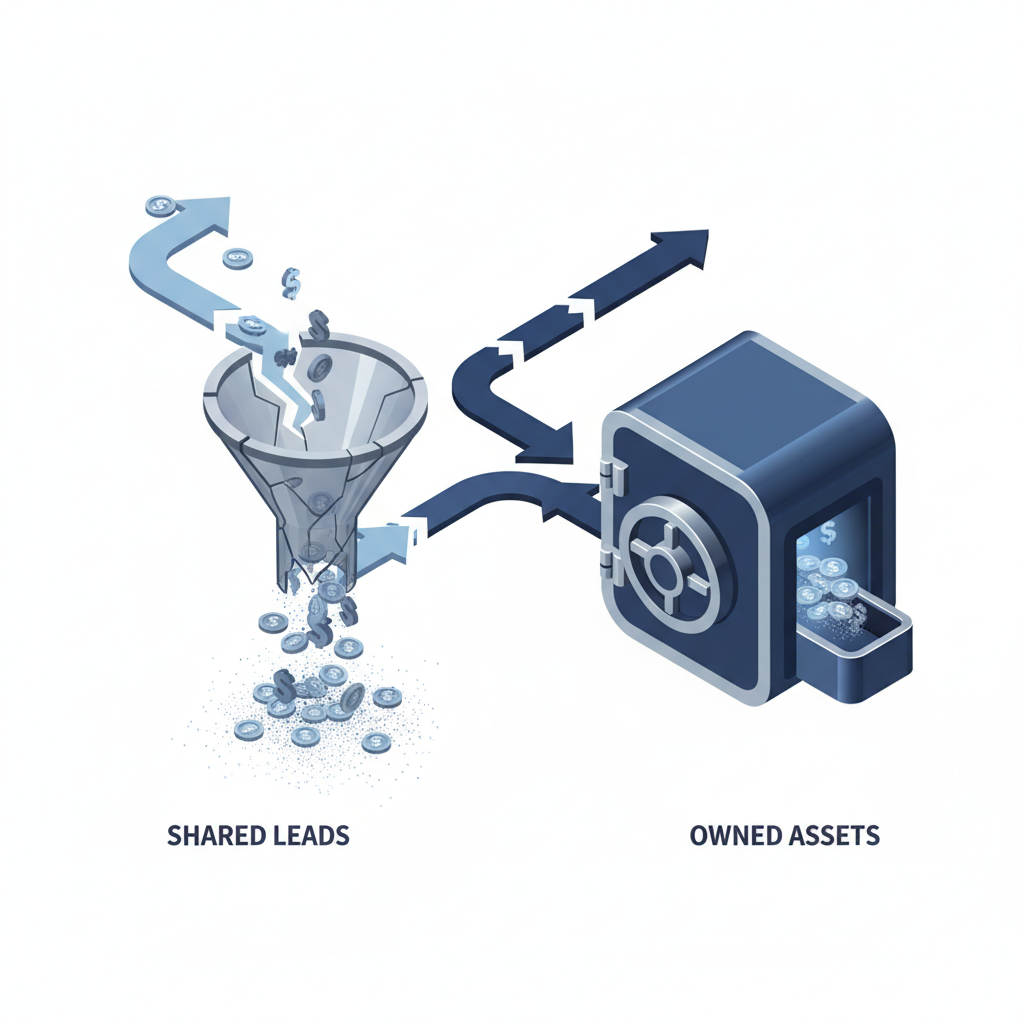
The Alternative: The Owned Asset
The contrarian perspective—the view held by the top 5% of trade businesses—is that marketing should build an asset, not just generate activity. An asset is something you own. It appreciates in value. It cannot be taken away.
Your own website, ranking locally in Google Maps, is an asset. A database of past clients who receive automated, seasonal maintenance reminders is an asset. A reputation management system that automatically requests reviews after a job is completed is an asset.
When a homeowner searches for "commercial electricians near me" and finds your brand directly, two things happen:
- Price Elasticity Shifts: They are calling you specifically. They have seen your reviews and your portfolio. You are not one of five quotes; you are the primary option.
- Zero Acquisition Cost: Once the infrastructure is built, that lead is free. There is no ‘pay-per-lead’ fee.
This sounds simple, yet many established firms hesitate. They fear the technical complexity. They worry that building their own infrastructure takes too long.
This hesitation is expensive.
The £1,200 Missed Call
Let us discuss a scenario that drains cash flow silently, every single week.
You are on a site visit. Your phone rings. It is a local number. You cannot answer because you are discussing a £20,000 extension with a client. You let it go to voicemail.
Data suggests that 60% of potential customers will not leave a voicemail. They simply hang up and call the next number on Google. In 2026, patience is non-existent. Speed is currency.
If that missed call was a standard boiler replacement or a consumer unit upgrade, that is £1,200 to £2,500 in revenue that just evaporated. Not because you weren’t good enough, but because you weren’t available.
If you miss three of those a month, you are bleeding nearly £40,000 a year in revenue. That is the cost of a full-time apprentice, lost to the ether.
Infrastructure Over Hype
This is where the conversation about "technology" usually goes wrong. You are bombarded with hype about "AI-powered sales bots" and complex funnels. A trade business does not need a robot that writes poetry. It needs a safety net.
This is the role Nexus plays. It is not a magic wand; it is essential infrastructure.
Consider the ‘Missed Call Text Back’ protocol. It is a simple, robust piece of logic. When you miss a call, the system immediately sends a text message: "Sorry I missed you, we’re just on a job. How can we help?"
This text halts the customer’s search. You have engaged them. You have bought yourself time to call them back. You have retained the lead.
This is not flashy. It is not something you boast about at the pub. But it is the difference between a leaky bucket and a watertight pipeline.
The Hardening Market of 2026
Looking ahead, the UK trade sector is bifurcating. There will be the "Commodity Trades" and the "Authority Brands."
The Commodity Trades will continue to fight in the shared lead pits. They will suffer as material costs rise and margins squeeze, because they have no pricing power. They are dependent on the aggregators.
The Authority Brands will own their data. They will have a database of 2,000 past customers in a CRM that automatically reactivates them for servicing and winter checks. They will dominate their local Google Maps results. They will use automation to ensure administrative tasks—invoicing, review requests, appointment reminders—happen without human error.
Regaining Control
Transitioning from rented leads to owned infrastructure requires a shift in mindset. It requires viewing your digital presence with the same seriousness as your physical fleet.
You would not rent a van that you couldn’t drive on Tuesdays. You would not use tools that belonged to your competitor. Why accept that compromise with your customer data?
Nexus is designed for the business owner who values this control. It is a consolidated command centre that replaces the fragmented tools—the separate email marketing, the standalone calendar, the disconnected CRM—and brings them under one roof.
The goal is reliability. When the market dips, you have a database to market to. When the staff are busy, the system captures the overflow. When you need to scale, the foundation is already laid.
By all means, keep the lead platforms as a secondary tap if you wish. But do not let them be the main water supply.
Build your own perimeter. Own your revenue.