The Volume Myth: Why Smart UK Trades Are Stopping Ad Spend to Fix Infrastructure in 2026

The Dashboard Dilemma
It is 5:30 PM on a Tuesday in November. You are in the van, navigating the M25 or the A1, heading home after a ten-hour shift. The dashboard phone mount lights up. It is an unknown mobile number. You ignore it because you are navigating a junction, or perhaps you are simply too tired to put on the "customer service voice."
That ignored call was not just a nuisance. In the current UK market, where homeowners demand immediacy, that missed call was likely a £3,500 boiler replacement or a £1,200 rewire job. By the time you return the call the next morning, the potential client has already booked a competitor who answered immediately.
For trade business owners operating between £250,000 and £1.5m in revenue, this is the defining operational crisis of our time. It is not a shortage of work; it is a shortage of capacity to handle the work efficiently. Yet, the prevailing advice in the industry remains dangerously outdated: "Buy more leads."
This is a strategic error. In 2026, growth does not come from shouting louder. It comes from listening better.
Myth vs. Reality: The Growth Trap
There is a distinct difference between a tradesperson and a Managing Director. The tradesperson looks for the next job. The Director looks for process stability. To make that transition, we must dismantle the myths currently draining your cash flow.
The Myth: "I Need More Leads to Grow"
Go to any trade show or open any industry magazine, and you are bombarded with offers to boost your SEO, manage your Google Ads, or upgrade your Checkatrade profile. The logic suggests that if you pour more water into the top of the funnel, you will get more revenue at the bottom.
This assumes your business is a watertight vessel. It is not. For most SMEs in the construction and service sectors, the business is a bucket with holes in the bottom.
The Reality: You Are Drowning in Opportunity Cost
Let us look at the fiscal reality of a standard UK plumbing and heating firm turning over £500k.
- Marketing Spend: You spend £1,500 monthly on lead generation platforms.
- Inbound Volume: This generates 40 viable inquiries.
- The Leak: Due to site work, driving, or administrative fatigue, you miss 30% of these initial calls.
- The Math: If your average job profit is £400, that 30% leakage costs you £4,800 in lost gross profit every single month. That is £57,600 a year—enough to hire a senior apprentice or upgrade your fleet.
Buying more leads when you cannot service the existing flow is not a growth strategy; it is a vanity metric that destroys net margin.
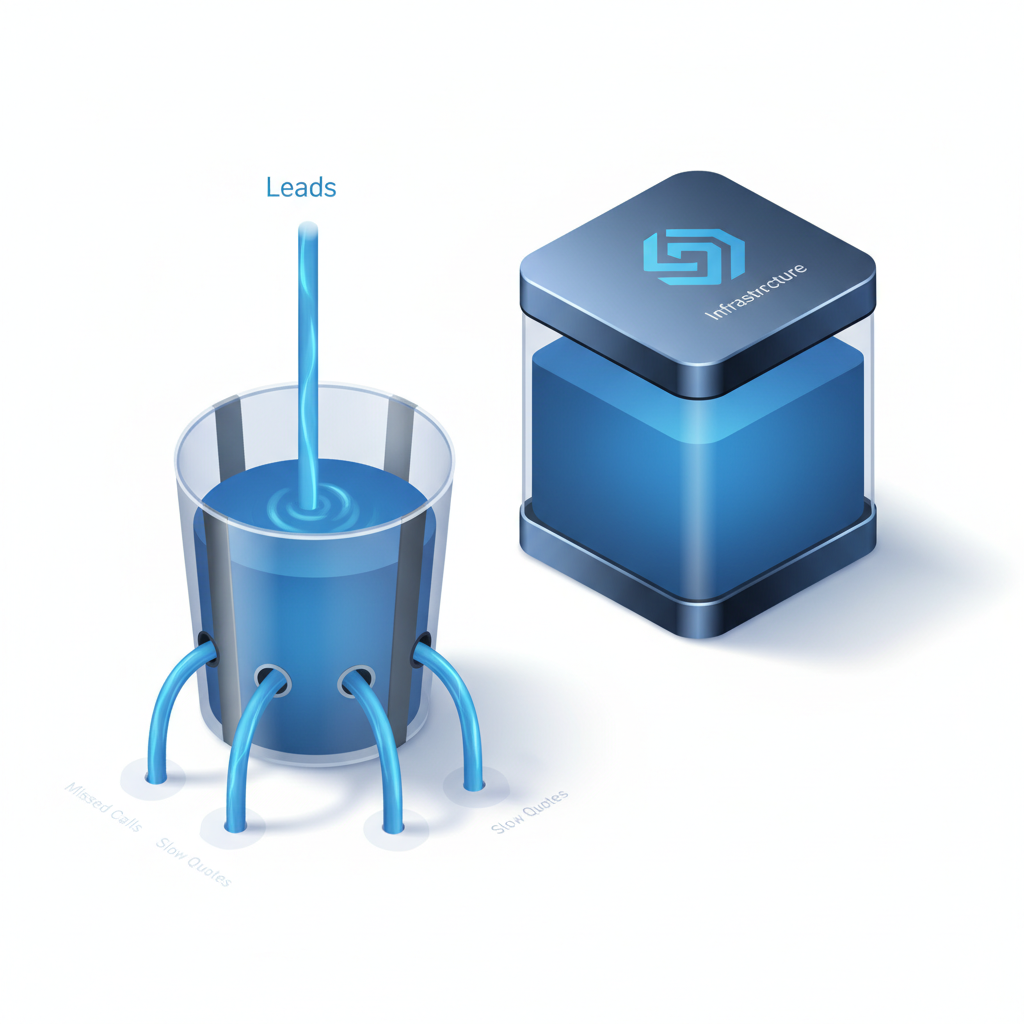
The Psychology of Control
Why do we obsess over lead volume? Because it feels like action. Setting up a new ad campaign feels like work. It feels like you are hunting. Fixing your administrative infrastructure, however, feels passive. It lacks the adrenaline of the chase.
But consider the anxiety that underpins your current operation. The fear that if you stop pedalling, the bike falls over. This fear stems from a lack of control. You are reactive, jumping every time the phone rings, apologising for late quotes, and scrambling to invoice on Sunday evenings.
To regain control, you must shift your focus from Acquisition (getting the phone to ring) to Capture (ensuring the phone is answered and the data is logged).
The Strategic Pivot: Infrastructure as an Asset
In 2026, the competitive advantage for UK trades will not be skill—there are plenty of good electricians and builders. The advantage will be reliability. The homeowner, tired of being ghosted by tradespeople, values the company that communicates clearly above the company that claims to be the cheapest.
This requires an infrastructure upgrade. You cannot be the Director, the Lead Engineer, and the Receptionist simultaneously. Historically, the solution was to hire office staff. But hiring a full-time admin manager costs £28k–£35k per annum, plus National Insurance, pension contributions, and the headache of HR management.
This is where Nexus serves as the bridge. We are not discussing "magic robots." We are discussing automated reception protocols.
How ‘Capture’ Infrastructure Works
Imagine a scenario where the operational burden is lifted from your shoulders without hiring new staff:
- Immediate Response: A call comes in while you are under a sink. You cannot answer. Instead of going to voicemail (where leads go to die), Nexus intercepts.
- Data Entry: The system converses with the client, not in a robotic way, but with the quiet authority of a staff member. It gathers the name, address, nature of the fault, and urgency.
- Triage: The system checks your calendar. It knows you are fully booked until Thursday. It offers a provisional slot for Thursday morning. The client accepts.
- Execution: You finish your job, check your phone, and see a booked appointment—not a voicemail asking you to call back.
This is not science fiction. This is standard operational procedure for high-growth firms. It turns chaos into a queue.
Fiscal Discipline and ROI
Let us speak strictly about the balance sheet. Implementing an automated capture system is a capital efficiency decision.
If you divert your £1,500 marketing budget into infrastructure that captures 100% of your current leads, your revenue increases without acquiring a single new customer. You are simply harvesting the crop you have already planted.
Furthermore, this stability improves your cash flow cycle. Automated systems can chase invoices and issue reminders. In the construction industry, where 60-day payment terms can strangle a business, having an automated ledger that politely but persistently nudges clients for payment ensures your liquidity remains healthy.
The 2026 Outlook
The UK trade sector is bifurcating. On one side, there are the chaotic operators: talented with their hands but disorganized, stressed, and capped at £300k revenue. On the other side, there are the strategic operators: those who have built a system that functions whether they are in the van or on holiday.
Your brand is not your logo on the side of the Transit. Your brand is the experience a customer has when they try to give you money. If that experience is difficult, friction-filled, or reliant on you returning a call at 8 PM, you are damaging your asset.
Nexus is not here to sell you leads. We are here to ensure you never waste one again. It is time to stop feeding the leaking bucket and start building a reservoir.